Traces of the image in Arjen Arî’s poetry
27.05.2026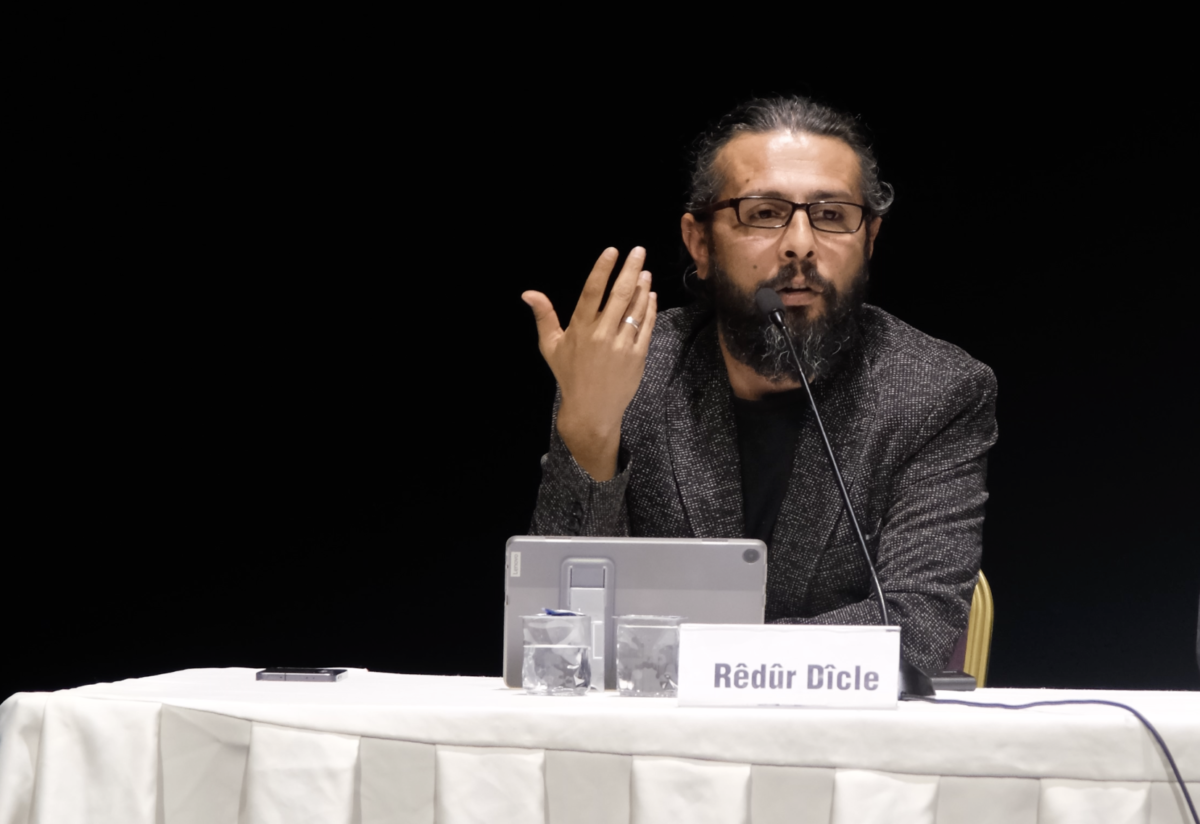
The literary and intellectual legacy of Arjen Arî, one of the cornerstones of modern Kurdish literature, was examined at a meaningful event. Rêdûr Dîjle, who delivered a presentation titled “Social and National Contexts in Arjen Arî’s Poetry” at the event, analyzed the master poet’s poetics through the concepts of national memory, patriotism, and intellectual consciousness.
Noting that the Kurdish people are currently going through a period when they need a shared social consciousness more than ever, Dîjle emphasized that recalling Arjen Arî’s emphasis on memory holds vital significance in such a process.
“Arjen Arî was a historian who etched everything into memory”
Rêdûr Dîjle began his speech by noting that Arjen Arî was not only a poet but also a historian who kept the collective memory of society alive, and went on to say:
“Arjen Arî has always been such a historian, and he remains one to this day. This is clearly evident in his works. That is why I would like to emphasize that, especially in the north, where significant developments are taking place regarding rights and freedoms—the freedoms of the Kurdish people and the foundation for building their own future—on the basis of a democratic society, organizing an event of this nature is, in my view, spot-on and of immense value. Especially when the focus is on Arjen Arî’s Kurdish identity and Arjen Arî himself, this value is amplified even further.”
Drawing attention to the importance of solidarity in this era, Dîjle continued her speech as follows:
“Perhaps no other period has made the need for Kurdish unity, alliance, and solidarity as imperative for us as this one. In my view, this period imposes this on us in every respect. Or perhaps no other period has brought this reality so deeply into our memory and consciousness. And in this period, Arjen Arî’s worldview, poetics, and perspective—along with his stance that always seeks to be remembered, to remind others, and to speak to memory—undoubtedly make him even more valuable. Because Arjen Arî has always focused on and emphasized the Kurdish cause through his works and productions within social, national, and humanistic frameworks.”
“He united his freedom with the freedom of this people”
Referring to the piece titled “Min Ji Bîr Meke” (Don’t Forget Me) in Arjen Arî’s work *Nazarî*, Dîjle quoted the poet’s definition of national memory as follows:
“Indeed, in the essay titled ‘Min Ji Bîr Meke’ (Don’t Forget Me) from the special edition of ‘Nazarî’—a work he longed to see published but did not live to see in print—he points precisely to this memory, to this issue. How so? He says: ‘If these lands are our roots and veins, then we are each a pomegranate on the tree; just like a pomegranate tree, we too need the sun and the air. But if you cut the tree from the soil or uproot it along with all its roots and veins, then just like a severed tree, it endures the same agony a dead person would suffer until it is swept away by the howling wind.” Here, Arjen Arî reminds us of national memory and consciousness within the context of the Kurdish cause. Here, he unites both his own oppression and his own freedom with the freedom of this people. And he says, ‘My freedom is everyone’s; everyone’s freedom is mine.’”
“National memory is not nationalism, but patriotism”
Emphasizing that the concept of “national memory” should not be confused with nationalism, Rêdûr Dîjle clarified the difference with the following words:
“I must point out—that is, we are only just beginning to make this distinction—that what I mean by Arjen Arî and national memory is certainly not something based on nationalism. On the contrary, it is based on patriotism. Because, in my view, nationalism has no connection whatsoever to patriotism or love of one’s homeland. Nationalism merely uses the values of the people and the nation as a tool for its own ends. Yet loving a country, protecting its culture and its differences, is not nationalism. These are values rooted in labor and the connection of that labor to the land, through which life is rebuilt.”
Referring to the devastation caused by the ideology of nationalism, Dîjle continued her speech as follows:
“Nationalism is a scourge upon humanity, and perhaps no other ideology has led to as many massacres and genocides as this ideology of nationalism. According to Arjen Arî, national memory is the sense of self within a society; it is being aware of Kurdish identity, culture, and history, and embracing them with heart and soul. This is directly linked to national consciousness and social values. In his view—that is, according to Arjen Arî—national memory begins with recognizing one’s language, culture, and history, and being aware of them. “At the same time, it strengthens, solidifies, and perfects the bond of belonging. According to Arjen Arî, national memory is not merely an individual quest for identity; it is the awakening and raising of awareness within society in this regard.”
“If we import poetry from abroad, everyone will make fun of us”
Explaining Arî’s clear stance on loyalty to the past legacy with an example from the poet’s 2012 interview, Dîjle used the following words:
“Indeed, as we just mentioned: ‘My freedom is everyone’s, and everyone’s freedom is mine.’ These lines clearly demonstrate this stance. Of course, when we consider this within a poetic framework as well; if I’m not mistaken, in an interview he gave with Tegord Hoca on İmece TV in 2012, he said: ‘We must build our poetry upon that deep-rooted poetic heritage. We must turn it into a lush, robust, and multi-branched tree. Otherwise, if we try to import a poem or a poetic style from abroad, sooner or later the whole world will mock us.” So here too, the fundamental dynamics of national memory and nationhood are present. You must draw nourishment from your past, make use of it, and build a solid bridge between the present and the future.”
“National memory is the perfect foundation of the struggle for freedom”
Referring to the political consciousness and social reality in Arjen Arî’s works, Dîjle concluded her presentation with the following words:
“According to Arjen Arî, national memory is the perfect foundation of the struggle for freedom. In other words, she does not limit this to a purely cultural framework. How so? He also refers to political consciousness here. According to him, resistance exists under this name within national memory, and solidarity gains meaning through it. For this reason, standing against any form of destruction—whether physical or cultural—makes national memory more visible and stronger. Indeed, this is clearly evident even from the titles of his works: When you look at the content, this is very clear in works like ‘Ramûsan Min Veşartin Li Gelîyekî’ (I Hid Kisses in a Valley), ‘Ev Çiya Û Spî ne’ (These Mountains Are White), ‘Şêrgele,’ and Arjen Arî’s reimagining of the Kawa epic… “That is what I understand from his perspective.”
Reminding the audience of the poet’s literary legacy, Rêdûr Dîjle concluded by addressing the listeners: “Those who seek freedom will never accept slavery or life under the yoke. You too must act with this awareness and stand up for your own language, culture, and values. This march is the only path that will illuminate the darkness.”
This news article was prepared with financial support from the German Embassy in Ankara as part of the “Strengthening Local Media Organizations through International Mentoring and Digital Transformation” project; our organization is solely responsible for the content.